
Central District Health administers individual septic permits in Ada and Boise counties. The owner supplies the site information and arranges test-hole excavation. CDH evaluates the evidence, writes the permit conditions, watches key installation steps, and completes the final record. A contractor can organize the field work but cannot replace that agency decision.
Start by proving the parcel is outside practical sewer service
Boise’s center is served by municipal or district sewer, and the City’s mapping covers the general service boundaries. That map also warns that it does not identify every connected parcel. An address can sit inside a boundary while an older house still uses a tank, or sit near a line that is not reasonably accessible for the proposed work.
Search the CDH record by legal description when an old street address returns nothing. CDH says its digital records begin in 1971 and some pre-2000 Ada County files did not migrate cleanly. A missing search result should trigger a records request rather than an assumption that no permit exists.
- Property street address and parcel number
- Legal description, subdivision, lot, and block
- Sewer provider or availability information
- Existing permit or as-built drawing if available
What goes into the Ada and Boise County application
The plot plan shows current and proposed structures, wells, water pipes, roads, streams, ditches, scarps, existing wastewater components, the proposed field, and a complete future replacement area. New buildings also require floor plans because bedrooms and design flow affect tank and absorption sizing.
CDH’s current instructions also require the owner’s lawful-presence documentation. Incomplete packages wait until the missing material arrives. A clean plan with dimensions saves more time than a sketch that forces the reviewer to guess about setbacks.
- Completed application and owner signature
- Scaled or fully dimensioned plot plan
- Floor plan for a new dwelling
- Current fee and required identity documentation
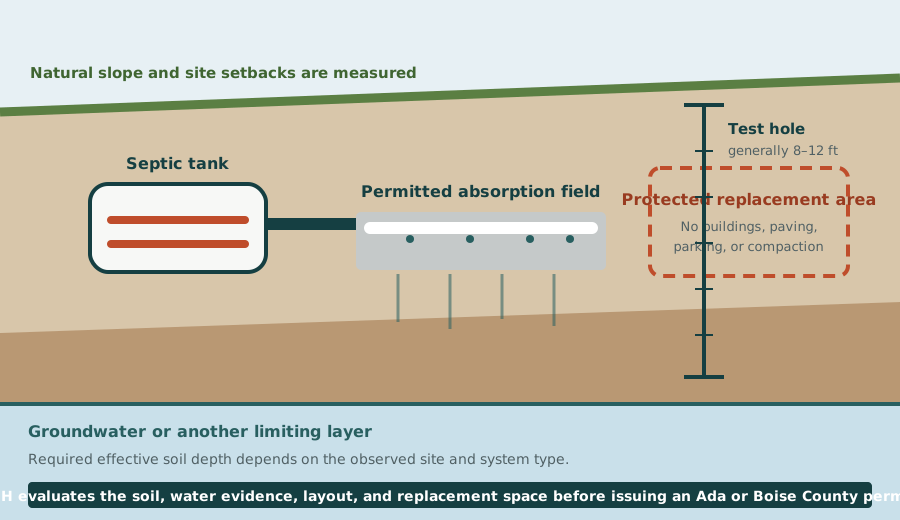
Test holes are generally 8–12 feet
The holes go near the proposed drainfield so the Environmental Health Specialist can observe the actual soil profile. CDH does not bring the excavator or supply labor. The owner or agent schedules equipment and coordinates the appointment with the assigned specialist.
Idaho’s rule groups soils by texture and treats claypan, duripan, hardpan, organic muck, high shrink-swell clay, and some coarse materials as unsuitable. A standard field also needs adequate depth above groundwater, rock, or an impermeable layer. Those findings can change field size, move the field, require an alternative, or end the proposal.
Groundwater evidence can control the calendar
CDH may call for weekly monitoring from February 15 through June 30. Irrigated land may also need readings from April 15 through October 31. The purpose is to capture the level that a drainfield must survive, rather than a convenient dry-day reading.
CDH posted a dated warning for the 2026 statewide drought: abnormally low groundwater measurements may need repetition in a more representative year. Anyone buying land should treat that as schedule risk and ask CDH what evidence the particular file still needs.
Fees and the final inspection belong to the agency
As of July 2026, CDH lists $1,070 for a new permit with a test hole or site visit and $535 for several no-visit scopes, including a tank-only permit. A repair with a test hole is also $1,070; a repair without one is $535. These are agency fees and can change.
After permit issuance, installation follows the approved drawing and conditions. Idaho requires appropriate installer registration for hired work. CDH inspects before a new system receives wastewater and creates the final as-built documentation. Call us for contractor-side coordination; contact CDH at 208-327-7499 for the official decision.